

Strategic Implications of the H2 2026 Government Land Sales (GLS) Programme
The Singapore government has released its H2 2026 Government Land Sales (GLS) programme. The announcement details 10 land sites (7 on the Confirmed List and 3 on the Reserve List), projected to yield approximately 4,575 private residential units for the final half of the year.
Latest Market Trends: The current landscape is characterized by resilient demand from multi-generational wealth preservation, local upgraders, and returning expatriate capital. We are observing a structurally tight supply environment, with investors increasingly focusing on spatial clustering and institutional luxury assets as defensive hedges against global economic volatility.
Rather than signaling a market correction, the data points toward a healthy period of capital consolidation, followed by a long-term upward trajectory as global liquidity continues to favor Singapore real estate. Below is a strategic brief on the three flagship sites that will shape prime and regional market pricing.
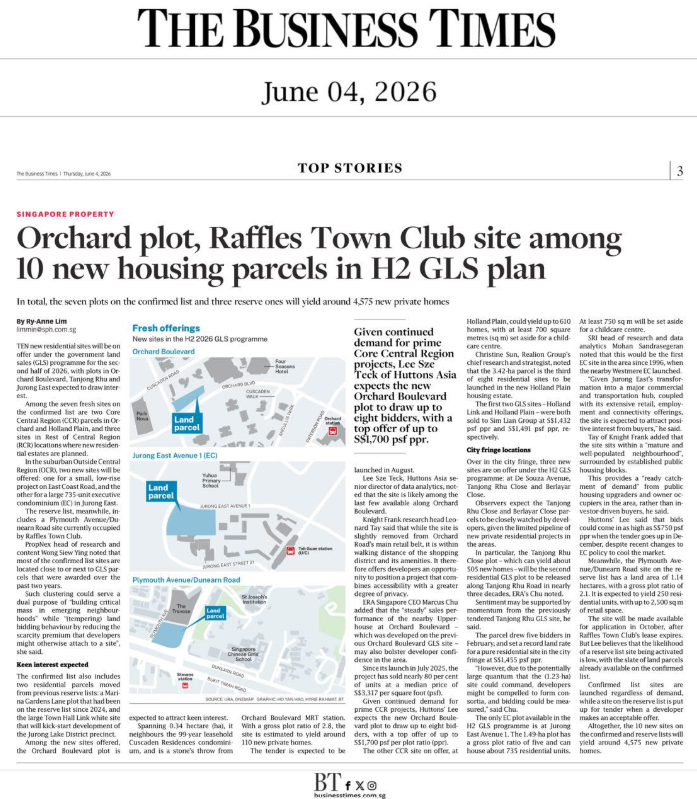
1. Orchard Boulevard: Institutional Luxury & Ultra-High-Net-Worth Scarcity
- The Asset: A rare, compact 0.34-hectare prime parcel situated adjacent to Cuscaden Residences, expected to yield an exclusive boutique enclave of roughly 110 units.
- The Valuation Context: Land bids are anticipated to test levels up to $1,700 psf ppr. This bidding behavior is heavily de-risked by recent ultra-luxury transactions; nearby project Upperhouse recently established a firm market benchmark with a median transaction price of $3,317 psf.
- Investor Takeaway: This site underscores the absolute scarcity of brand-new Core Central Region (CCR) land. For capital allocators looking to park wealth in highly defensive, generational real estate, the entry pricing of this downstream launch will represent the new premium benchmark for Orchard luxury.
2. Tanjong Rhu Close: Elite City-Fringe Opportunity
- The Asset: A substantial plot yielding roughly 505 units, marking only the second residential GLS release in this highly coveted waterfront enclave in the last 30 years.
- The Deal Dynamics: The large capital quantum required for a project of this scale means developers will likely pool resources via joint ventures or consortiums. Historically, consortium bidding reduces the absolute number of tender participants.
- Investor Takeaway: Fewer active bidders at a land tender typically translates to more measured, rational land pricing relative to highly contested smaller plots. Following the record city-fringe benchmark of $1,455 psf ppr set nearby in February 2026, this site offers private investors a highly advantageous downstream entry point into a historically supply-starved submarket.
3. Jurong East Avenue 1: The Gateway Executive Condominium (EC)
- The Asset: A highly anticipated 735-unit Executive Condominium site. This marks the first time an EC land plot has been introduced to the Jurong regional hub since 1996.
- The Macro Fundamentals: Over the last three decades, Jurong East has undergone a complete economic and structural metamorphosis, evolving into Singapore’s largest secondary commercial, retail, and transport hub.
- Investor Takeaway: While policy adjustments regarding tighter income ceilings for EC buyers may create localized, short-term demand dampening, the fundamental wealth-creation mechanism of the EC asset class remains uncompromised. Backed by massive pent-up demand from a dense local employment base, this site represents an excellent, highly resilient vehicle for suburban portfolio exposure.
The Macro Perspective: Spatial Clustering
A key trend in the H2 2026 release is the deliberate clustering of Confirmed List sites near previously awarded parcels in Tanjong Rhu and Holland Plain.
The state is intentionally focusing planning resources to build deep critical mass and world-class infrastructure within specific premium corridors, rather than spreading inventory thinly across the island. For investors, buying into these high-concentration clusters ensures that capital growth is directly aligned with targeted state infrastructure spending and long-term urban transformation.
Disclaimer: This post is for informational and educational purposes only and does not constitute formal financial, investment, or legal advice. Real estate investments carry inherent risks, and past performance is not indicative of future results.